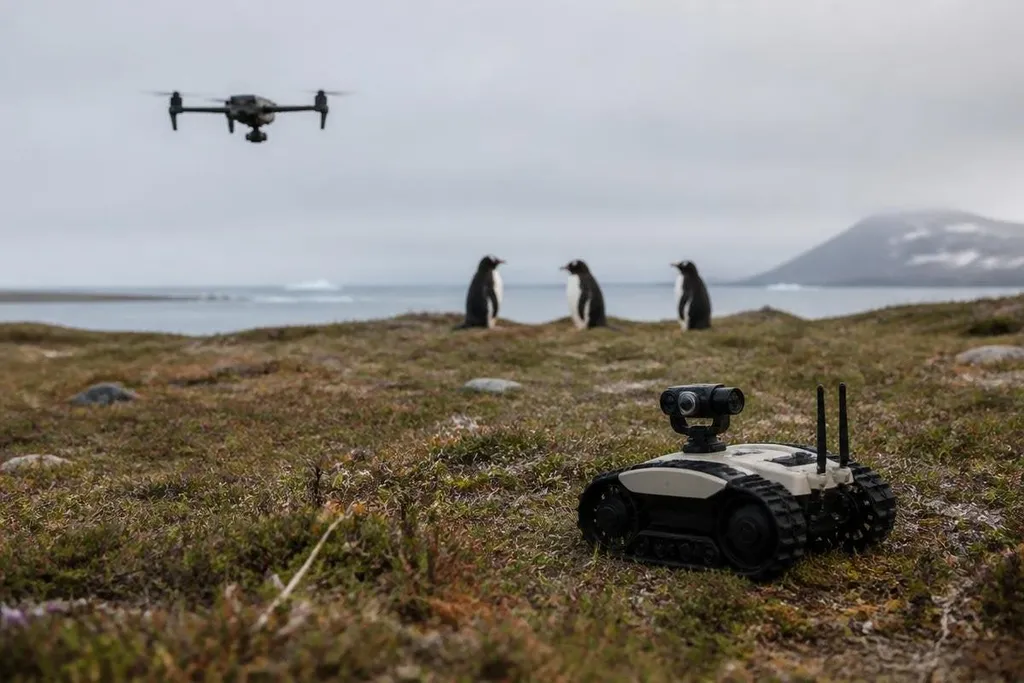
A wildlife robot can enter a place that is unsafe, hard to reach, or easily disturbed by people. Its cameras and sensors can collect observations while researchers stay farther away, but the robot still becomes part of the habitat.
- Longer observation with less human presence
- Better access to rough or risky ground
- New risks from noise, movement, and stored data
Where robots can help
A small ground robot can move through vegetation, carry a camera, and send images to a remote operator. An aerial robot can view nests, shorelines, or wide areas without sending a person into the same space.
The useful result is more observation from a safer distance.
That distance matters when animals react to people. A robot may let a research team check a site without walking through nesting ground or approaching a herd. The benefit depends on the robot’s size, speed, noise, and route, not on the word “autonomous” in its product description.
Robots can also return to the same location and collect data in a consistent way. Repeated images from one route may help show changes in vegetation, water, animal presence, or signs of damage. A fixed method makes later comparisons easier, though it does not remove the need for human review.
The animal may still react
Wild animals can respond to a robot as they would to any unfamiliar object. A moving platform may cause an animal to leave shelter, change its feeding route, stop calling, or avoid a site. Even a quiet machine can create a problem if it appears near a nest or blocks a normal path.
The risk grows when a robot repeats the same approach. One short visit may have little effect, while regular passes could change behavior over time. Teams need to watch the animals’ responses and change the route, speed, timing, or distance when those responses appear.
An aerial robot brings extra concerns. Its shape and sound can resemble a predator to some birds or other animals. A ground robot can damage plants, disturb soil, or become trapped, leaving equipment in the habitat and adding work for the field team.
Data is part of the design
A wildlife robot does more than move and record. It creates files that may show an animal’s location, a nesting site, or a rare species. That information can cause harm if people use it to find animals for collection, tourism, or illegal hunting.
The team should decide who can access the data, how long it will be stored, and whether exact location details need to be hidden. The same rule applies to live video feeds. A remote operator who sees an animal in distress may need a clear plan for when to stop the robot and call local staff.
A wildlife robot’s field test should name the species, habitat, sensor, test date, and result. Robot24.com can put those facts beside reports on the machine, giving a conservation team a clearer record before it plans how to recover the robot when field work goes wrong.
A robot also needs a recovery plan. The team should know how to retrieve it after a battery failure, signal loss, collision, or weather change. A machine left behind can become litter, block an animal’s path, or expose a sensitive location through its stored data.
A field checklist before deployment
Use these checks before a robot enters wildlife habitat:
- Set the purpose. Name the observation the robot must collect and remove functions that add no useful evidence.
- Test the approach. Check noise, lights, movement, size, and ground contact away from animals before field use.
- Choose a stop rule. Define the behavior that will end a run, such as repeated flight, alarm calls, or route avoidance.
- Limit the data. Store only what the project needs, protect location records, and set an access list.
- Plan recovery. Keep a person, spare power, and a safe retrieval route ready for equipment failure.
- Review the record. Compare robot observations with field notes so the machine’s view does not become the whole account.
The practical choice
Wildlife robots make the most sense when they reduce human disturbance without creating a new disturbance of their own. I’d use one only after a quiet test shows that the machine can collect the needed evidence at a safe distance.
The open question is simple: does the robot leave the habitat with more useful knowledge than stress? If the team cannot answer that from its field records, the deployment needs a different design.